
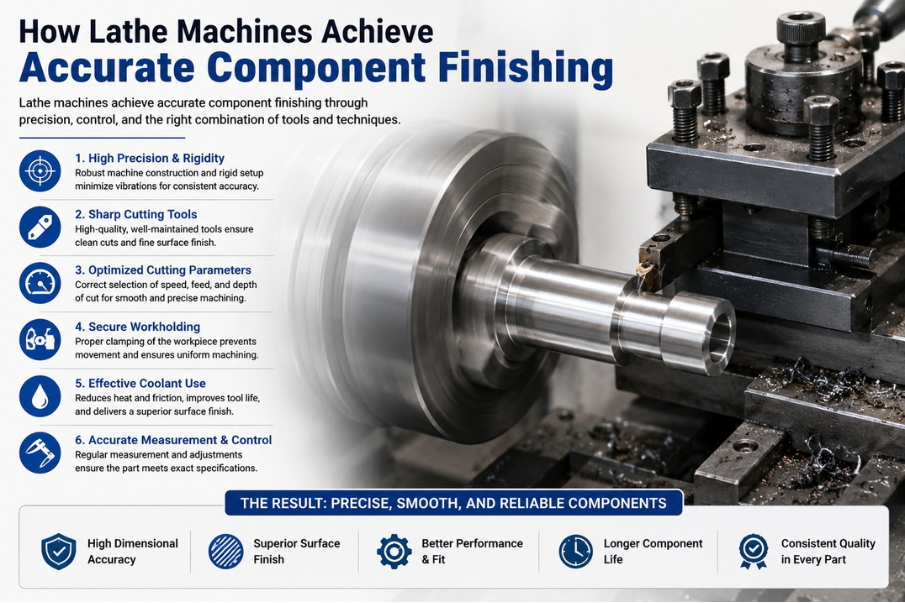
Surface finish and accuracy are some of the major considerations when producing industrial components in modern times. This is attributed to the fact that sectors such as automobiles, aviation, and medical devices require accurate machining processes.
Lathe machines assist in creating exact pieces through the turning of the piece with respect to the cutting tool. Lathe machines are more efficient in the modern age due to computer numeric control (CNC).
Understanding the Role of Lathe Machines in Precision Machining
Lathe machines are mostly used for the purpose of shaping, cutting, drilling, threading, and machining metallic parts. This is achieved by rotating the component and removal of any unnecessary material from the component.
Their precision in machining results in the production of accurate dimensions as well as smooth surfaces. The modern day CNC lathe machine improves production through automated machining processes.
Key Ways Lathe Machines Achieve Accurate Component Finishing
1 Precise Material Removal
Accuracy in finishing of lathe machines is facilitated through the accuracy in the removal of materials. This is possible by cutting away the unwanted material from the workpiece through the use of cutting tools.
This process helps achieve:
- Uniform component dimensions
- Smooth surface finishes
- Accurate component sizing
- Reduced machining irregularities
Machining depths, cutting speeds, and feeds may be controlled to fit the materials and degree of finishing that one needs. Proper control of the machining processes will play an important role in improving consistency while reducing errors and waste of material in production.
2 High Rotational Accuracy
High rotational accuracy of the lathe machine is essential for machining accuracy and good surface quality. A stable spindle system makes it possible for the object to rotate without any vibrations.
Consistent rotational movement helps:
- Maintain uniform cuts
- Improve dimensional consistency
- Reduce surface defects
- Produce smoother finishes
The modern lathe machines have incorporated modern spindle technology that enables consistent machining even during high-speed operations.
3 Advanced Tool Control Systems
Modern lathe machines are equipped with advanced tool control systems that help in achieving efficiency and machining accuracy. Precise positioning of cutting tools helps in eliminating material from correct areas only.
Benefits of advanced tool control include:
- Better dimensional accuracy
- Improved surface quality
- Reduced finishing defects
- Consistent machining performance
In CNC lathe machines, automated tool movement allows multiple machining operations to be performed with high precision and repeatability.
4 Smooth Surface Finishing
Surface finishing is important because it directly affects component appearance and performance. Lathe machines are capable of producing smooth and polished surfaces through fine cutting operations and optimized machining settings.
Several factors improve surface finishing, including:
- Proper cutting speed
- Balanced feed rates
- Sharp cutting tools
5 Effective coolant systems
Smooth finishes help reduce friction in moving assemblies, improve fitting accuracy, and increase component durability.
6 Tight Dimensional Tolerances
Many industrial applications require components with extremely accurate measurements and minimal variation. Lathe machines are highly effective at maintaining tight dimensional tolerances during production.
Precision machining helps manufacturers produce parts with:
- Exact measurements
- Consistent dimensions
- Reliable fitting performance
- Improved assembly accuracy
Modern CNC lathe machines equipped with digital systems can maintain close tolerances across large production batches.
7 CNC Automation for Enhanced Accuracy
Computer numerical control (CNC) technology has been able to boost the efficiency of lathe machines. Computer numerical control (CNC) refers to the application of technology that automates the machining process by computer-controlled commands.
Advantages of CNC lathe machining include:
- Higher machining accuracy
- Faster production speed
- Better consistency across batches
- Reduced manual intervention
- Support for complex machining operations
Important Features That Improve Finishing Quality
Rigid Machine Construction
A strong and rigid machine structure helps reduce vibration during machining operations. Better machine stability improves cutting accuracy and surface finishing quality.
Heavy duty frames ensure industrial application and machining accuracy.
High-Quality Cutting Tools
The quality of cutting tools directly affects component finishing quality. Sharp and durable tools produce cleaner cuts and reduce machining defects.
Carbide, ceramic, and coated cutting tools are commonly used in precision machining because they provide better wear resistance and longer operational life.
Speed and Feed Rate Control
The proper regulation of the speed and feed rate is critical in order to obtain good surface finish and accuracy of machined parts. Appropriate machining conditions minimize heat generation and prevent excessive wear of tools.
Incorrect machining settings may result in poor finishing quality and reduced production efficiency.
Coolant and Lubrication Systems
Coolant and lubrication systems are used to control heat generation during machining operations. Good cooling prevents damage to both workpieces and cutting tools due to high temperatures.
Benefits of coolant systems :
- Improved surface finishing
- Better chip removal
- Increased tool life
- Reduced surface defects
Effective lubrication also supports smoother machining performance and consistent finishing quality.
Applications of Accurate Lathe Machining
- Automotive Industry
Lathes machining is applied widely in manufacturing automobile products such as shafts, pistons, bushes, brakes, and engine components.
- Aerospace Components
High precision machining is required in the aerospace sector for the production of turbine parts, aircraft fasteners, and structural parts.
- Industrial Shafts and Bushings
Lathe machining can also be applied in the production of industrial shafts and bushes in order to ensure that their dimensions are exact.
- Medical Equipment Components
Medical devices and equipment usually need precise dimensions and good surface finishing, thus lathe machining is widely used in the medical industry.
Benefits of Accurate Lathe Machining
Lathe machining offer many advantages for modern manufacturing industries:
- Improved product quality and consistency
- Better dimensional precision
- Smooth surface finishing
- Reduced material wastage
- Increased production efficiency
- Enhanced component durability
- Reliable repeatability in mass production
Wrap up
The lathe machine is important in ensuring that there is accurate component finishing. The lathe machine has been able to facilitate material removal, rotational stability, tool control, and surface finishing that makes it very important in the current manufacturing processes.
With the advancement in technology, especially the introduction of CNC automation, today’s lathe machine has been able to provide precision, increased production, and quality in the manufacturing process.