
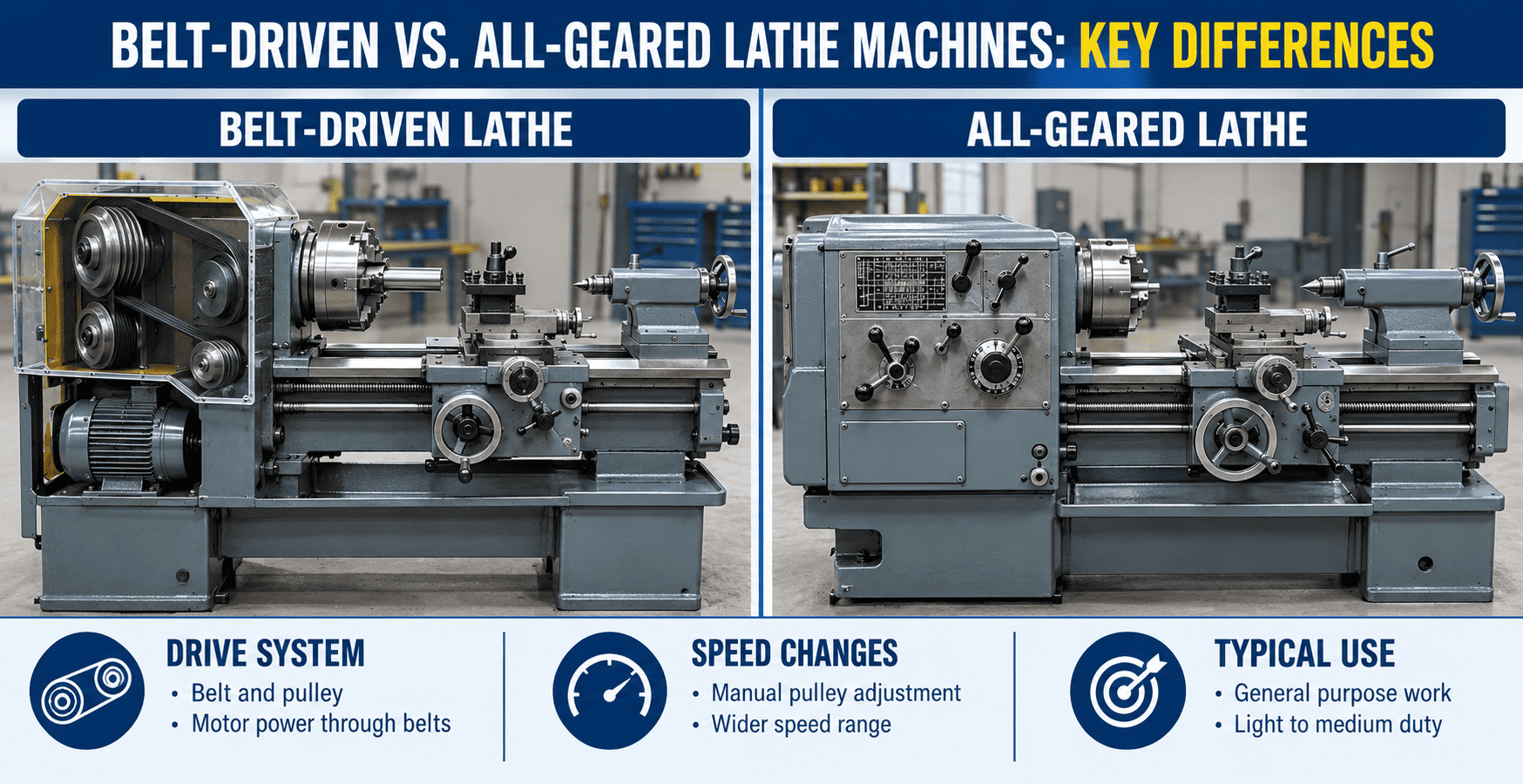
The choice of whether to go for an all-geared lathe or a belt-driven lathe will depend on what one seeks to achieve from the equipment. It may be in a workshop, production environment or training institute. Two main types are usually considered and these include the belt-driven lathe and the all-geared lathe. The latter is powered in a completely different way than the former but performs the same role. They both rotate a workpiece by means of a cutting tool.
What Is a Belt-Driven Lathe?
In a belt-driven lathe, the transmission of power from the electric motor to the spindle occurs via a belt that wraps around a stepped cone pulley. The speed of the spindle can be altered by shifting the belt to a new position on the pulley. Some designs also employ back gears to achieve slower speeds with higher torque.
Benefits
Affordability: The design is simple, hence making it cheap to buy and operate.
Maintenance: It uses belts that are cheap and easy to replace, and most repairs do not require special expertise.
Smooth operation: The belt acts as a buffer for vibration, resulting in smooth operation of the machine.
Protection against overloads: In case of overload, the belt slips rather than damaging the motor or spindle.
Limitations
Limited number of speeds: The number of speeds is restricted to the number of steps on the pulley.
Reduced power: Belt slipping leads to the reduction in the power reaching the spindle.
Limited speed shifting: The belt has to be shifted manually.
Does not suit large cuts: Large cuts on hard metals may cause overloading of the belt.
All Geared Lathe Machine
An all geared lathe machine is one of the heavy-duty lathes among other lathe machines that have been designed for use in production purposes. An all geared lathe machine uses gears for transmitting the power from the motor to the spindle via the gearbox that is contained in the headstock. This lathe machine does not have any belt drive, because it is driven through the use of a gear train.
Advantages:
- Large range of speeds: One machine is capable of offering a wide range of spindle speeds, from slow roughing speeds to high finishing speeds.
- Positive drive: Gears do not slip; therefore, the power delivered to the spindle is consistent.
- Quick changes of speed: Changing speeds via the lever only takes a few seconds.
- High capacity: The sturdy design allows deep cutting, hard materials and tight tolerances.
Disadvantages:
- Increased cost: Due to the gearbox, the machine becomes expensive to purchase.
- Maintenance difficulty: Repairing the gearbox requires experienced personnel and replacement gears may be expensive.
- Noisy: Gear meshing generates more noise compared to a belt drive.
Belt-Driven vs. All-Geared Lathe: Side-by-Side Comparison
| Feature | Belt-Driven Lathe | All-Geared Lathe |
|---|---|---|
| Power transmission | Belt and cone pulley | Gearbox |
| Speed selection | Manual belt shifting | Lever-operated |
| Number of speeds | Limited | Wide range |
| Power loss | Slippage possible | Minimal |
| Accuracy | Moderate | High |
| Heavy-duty cutting | Not suitable | Well suited |
| Noise level | Low | Higher |
| Initial cost | Low | High |
| Maintenance | Simple and cheap | Complex and costly |
| Typical use | Training, light work | Production, industrial work |
Which One is Better for You?
Go for the belt-driven lathe when you are:
- Running a training center or technical college.
- Performing light work, for example, machining of small pieces in soft metals.
- Operating with a tight budget.
- Interested in having maintenance-free machinery.
Opt for the all-geared lathe when you are:
- Machining parts on a large scale and with high precision.
- Working on alloys of hard metals.
- Required to change speeds frequently.
When neither of these extremes describes your needs, consider the future plans of the business. For instance, a small company which will grow in the future might consider purchasing a geared machine.
Conclusion
Both the lathes have their own advantages; there isn’t one which is better than the other in all situations. The belt-drive lathe is simple, economical, and easy for light-duty work while the all-geared lathe is powerful, accurate, and quick for high-speed control during production. It’s all about selecting the right equipment for your material, volume, and budget requirements.
FAQS:
Which lathe is more accurate than the other?
Generally speaking, the all-geared lathe. The positive gear drive allows for more precise power transmission and handling of cutting loads.
Can the belt-driven lathe work on metal?
Yes. It does a good job of working with light to medium materials such as mild steel, aluminium, and brass. It is not the best choice for roughing operations.
Which lathe will last longer?
Both lathes can last for many years. The belt-driven lathe requires periodic replacement of the belt while the all-geared lathe requires regular lubrication.
Which is the better machine for a novice?
The belt-driven lathe is a good machine for the novice.