
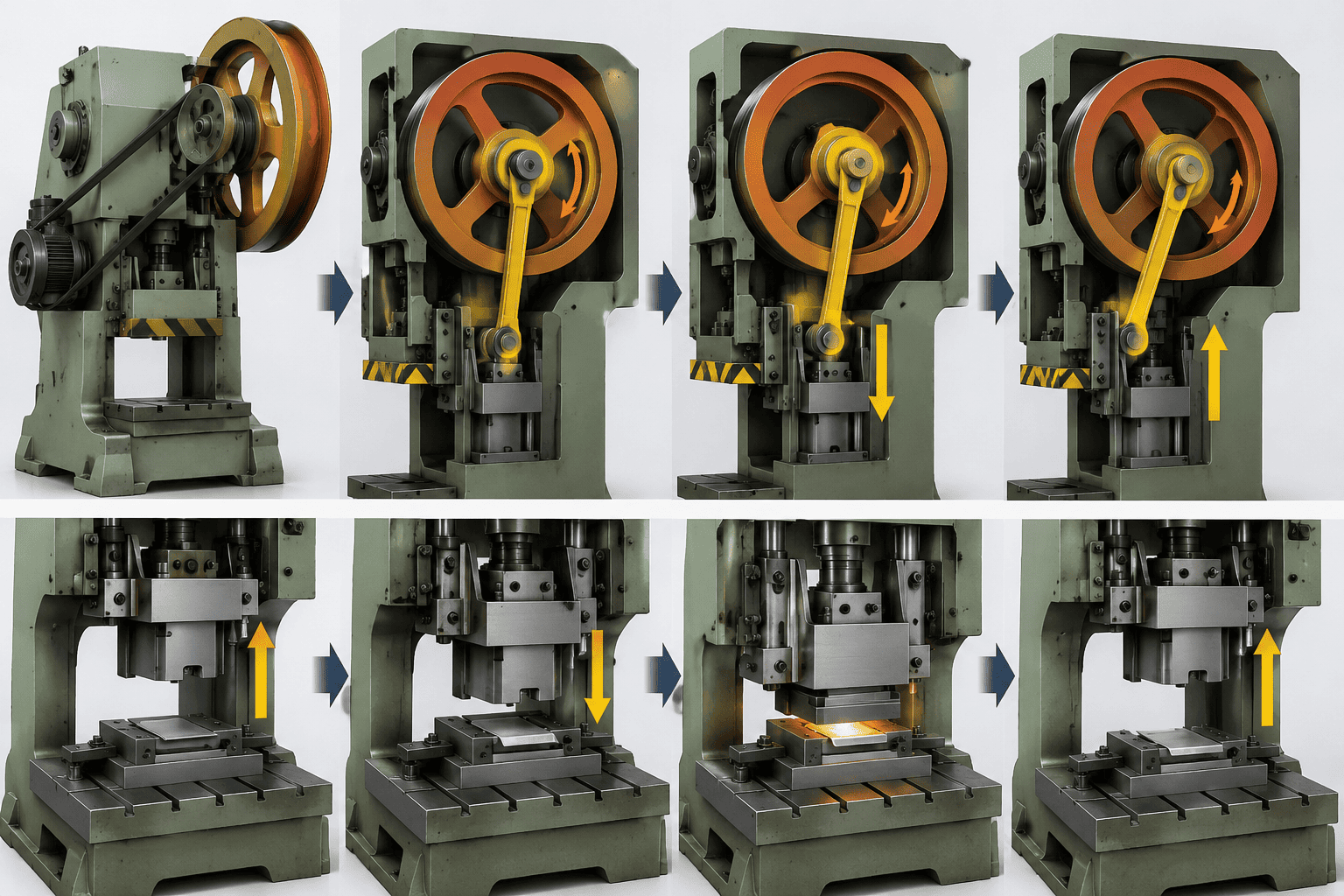
A sheet metal component, be it a bracket, a tool, or an automobile panel, begins its existence with the press, which stamps it in just one second. The industrial power press machine performs stamping action using the process where a constant motion of an electric motor is converted into a single strong stroke. The knowledge of this process will help in the selection of the proper device and in its operation.
The Basic Principle
The power press produces no force directly at the point of interaction. Power press gathers the force produced by an electric motor, holds it, and delivers in a short stroke. The chain is very simple: source of energy - energy accumulation - motion transformation - force production.
How a Power Press Works: From Motor Power to Metal
1. Electric Motor and Flywheel: Storage of the Energy
An electric motor spins a heavy flywheel via a belt or gear mechanism. This flywheel is constantly rotating and storing energy in the form of kinetic energy. Since the press works for a limited period during the cycle, this energy is released by the flywheel at that moment and allows for the usage of a small motor delivering large force.
2. Clutch and Brake: Control of the Stroke
Clutch is used to connect the flywheel to the crankshaft during operation of a stroke by an operator. Brake is used to stop the stroke at the end of the cycle. It is essential for safety.
3. Crankshaft and Connecting Rod: Converting Rotational Motion Into Linear Motion
The crankshaft has an off-center portion and it is connected with the slide with the help of a connecting rod.
4. Slide (Ram) and Dies: Transferring Force to the Work
The slide is guided to move in perfect alignment by means of precision guides. The upper die is mounted on the slide, whereas the lower die is fixed on the bolster. As the slide goes down, the dies come together and carry out processes like blanking, punching, bending, forming, and drawing on the sheet metal. Maximum force generated by the press is exerted at the bottom of the stroke.
5. The Frame: Withstanding Reaction Force
The frame withstands the reaction force generated during each stroke. This is achieved using a strong C-frame or straight-side frame.
Role of Power Press Machine Manufacturers
Every efficient press requires a manufacturer who knows all the engineering nuances well. Power press machine manufacturers do not just put together various components of a press. On the contrary, their job includes such aspects as:
- Designing and engineering: Tonnage calculation, stroke determination, strength analysis of the frame and the crankshaft in order to ensure that the press can operate within its capacity range efficiently.
- Casting and machining: Production of the press frame, bed and slide from high-quality cast iron or steel. Then stress relieving of the metal to make sure that it does not deform throughout its long operating life.
- Precision machining: Crankshaft grinding, gibbing and boring the bearings.
- Assembly and testing: Installing clutch, brake, motor and the control system, followed by no-load and load testing prior to delivery.
- Customisation: Altering the bed length, stroke length, speed or feeding method to fit a particular part or assembly line.
- After sales service: Providing replacement parts, installation and servicing, which are equally important as the press itself.
A good manufacturer should also abide by recognised standards of safety and quality, including appropriate guarding, overload protection and testing. The careful control of these processes by a manufacturer enables the buyer to acquire a well-functioning press with precision and minimum need for unexpected maintenance.
Why Industries Choose Such a Machine Design
Industries like automotive, electrical, hardware, appliances, and fabrication have their reasons to use mechanical presses:
- Speed: Short cycles match the requirements of large-scale manufacturing.
- Consistency: Every operation is carried out with the same stroke length and force curve.
- Economical: The flywheel regulates energy consumption.
- Multi-purpose: A single machine performs various operations using different dies.
- Economical operation: Simple design makes the machine easy to maintain.
What a Buyer Must Look For
A buyer’s choice of press machine does not depend solely on cost considerations. Important criteria are:
- Tonnage: It should be larger than the maximum force required by your most difficult work, leaving some safety margin.
- Bed and bolster size: It should match your die sizes.
- Stroke length and speed: They should match your depth of stamping and quantity of products needed.
- Press frame: C-frame is preferred for convenient loading; straight-side is good for high precision and strength.
- Safety devices: Light curtains, two-hand controls, overload protection and guarding of moving parts.
- Quality construction: Castings, bearings, crankshaft should be of high quality and well manufactured.
Maintenance Tips for Long Life
- Maintenance Tips for Increased Lifespan
- Lubricate slide, gibs and bearings.
- Check clutch and brake lining wear.
- Make sure that all bolts and tie rods are tightened.
- Maintain clean dies in proper alignment.
- Do not exceed tonnage capacity.
Conclusion:
The design of a power press is excellent mechanical engineering because a flywheel stores energy, the clutch regulates energy flow, the crankshaft translates rotary movement into linear movement, and the slide applies the force to the die. Regardless of whether you have a small or big shop, having a good industrial power press machine by the right manufacturer will have an impact on your production quality and profits.